
On our internal wiki we have the following AI policy, that we stick to and rigorously police:
Stupendium Softworks will never knowingly use generative AI on any project we create; we believe that it diminishes the creativity and learned skill of real human beings. We take steps to ensure that no AI generated work is used on our projects, and, if anyone is found to be using generative AI to produce content, they will no longer be contracted to produce work for our games.
This policy is important to me, Stupes, and all of our Stupengineers and there’s a tonne of reasons as to why we take this strictly no Generative AI approach.
We are a team of incredibly skilled creative human beings, and we all understand that the creative process is one of the most fulfilling and important parts of what makes this job, and generally being a human, great. Taking an idea from conception to completion is the whole reason we got into this business, really. Solving problems gives our brains a little buzz, creating and iterating is what we’re good at. We love to make mood boards, discuss ideas, and “yes and” each other whenever possible.
When you put Generative AI into this process, it takes a lot of that process away and hides it in a black box. It strips back the hours of thinking, collaboration and soul from a feature and reduces it to a homogenised blob of computer generated slop. It takes the spark of creation, one of the big things that make us human, and turns it into a prompt and a button press… essentially snuffing it out. This is to say nothing about the stolen works of our fellow artists, or the impact Generative AI has on our planet.
I could never put myself in that kind of situation, and I don’t think any true creative could look at this stuff and not recoil too – because real creative people know the journey is just as important as the destination. When you use Midjourney, the journey becomes absolutely mid (that’s what the kids say… right? I’m relevant.)
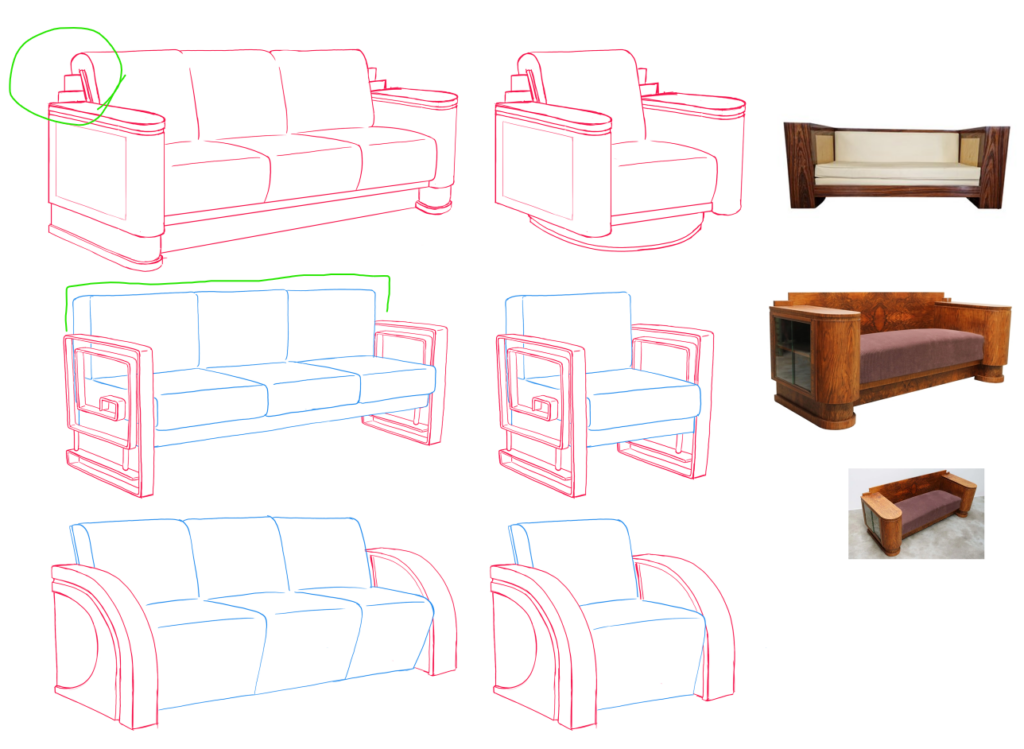
It’s not easy to avoid Generative AI nowadays, every big tech executive is trying to normalise and force it down our throats. It’s aggressively marketed. You can’t even google nowadays without sending a prompt to an AI to get an answer that may or may not be correct. We often struggle within the studio when we’re looking for reference work as part of our art pipeline because the search engines are so saturated with AI generated images.
I often talk about the “woodgrain” of a videogame when discussing game development. It’s the idea that if you spend too long balancing a game to mathematical perfection, or trying to ensure every player has an almost identical experience, you risk sanding away a certain je ne sais quoi that gives the game its character.
I think of it like a well-made chair built from high-quality wood. Run your hand across it and you can feel the subtle imperfections of the material, the grain and texture that remind you it is real, and it was made by someone. Whereas if you compare that to something cheap and mass-manufactured, the surface might have a thin, smooth veneer designed to look like wood without really feeling like it.
Games are the same. If you keep sanding away every rough edge, oddity and human imperfection in pursuit of a perfect experience, you can accidentally sand away some of the soul with it. Sometimes those little flaws are the woodgrain. They’re the things that make a game feel handmade, give it an identity, and ultimately help other people connect with it.
Generative AI content does this, at least in my opinion. When I see AI slop on posters in the real-world now, or those godawful animations on TikTok everywhere, I can feel deeply within my core that what I’m seeing has no soul. All these generated non-people are weirdly smooth, their voices are creepy, they have these thousand yard stares that betray that there’s no soul behind them. It’s all so cringey and wrong. Even the people who spend hours of their lives writing and rewriting prompts create work that feels soulless and uncanny under the surface.
I think everyone knows this deep down – its why even the people that use Generative AI tend to try to hide it as much as possible, and then if they get caught, they’ll double down. The people who do openly use Generative AI, in my experience tend to be vice-signalling and don’t often care for art or the time it takes to create real art… and they get super defensive when you call them out about it.
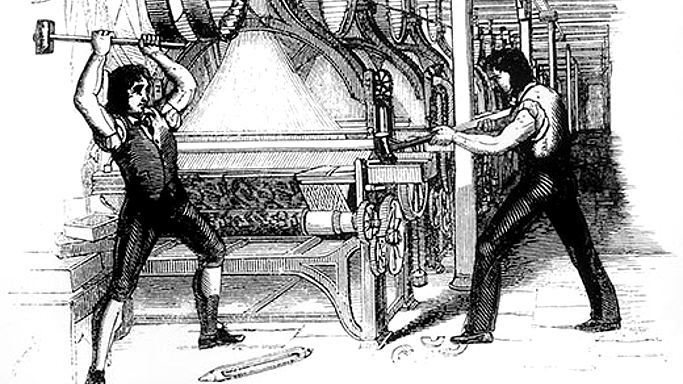
Many Generative AI supporters argue that people who don’t want to use AI are akin to the luddites of the early industrial revolution, I suppose in some ways they are right:
It is a common misconception that the Luddites were stupid, anti-technology or unable to keep up with progress, when in fact many of them were skilled workers that used technology in their work. In the 2004 book, Writings of the Luddites, Kevin Binfield says that they focused their attacks on industrialists that acted in “a fraudulent and deceitful manner” by using terrible labour practices including child labour, cutting worker pay and dangerous working conditions. Binfield stated that the Luddites “wanted these machines to be run by workers who had gone through an apprenticeship and got paid decent wages.”
Wealthy industrialists built their new spinning machines on the backs of stolen slave labour, Generative AI executives have built their machines by stealing the collective literary and artistic works of humanity – both have been exploitative of human beings. The industrial revolution and generative AI have had dramatic impacts on workers too: putting people out of jobs and replacing skilled and often expensive laborers in favour of cheaper machines.
The industrial revolution eventually contributed enormously to higher living standards, but its early decades it produced appalling working conditions, child labour, pollution, dangerous factories, overcrowded cities and huge imbalances in the concentrations of wealth.
Industrialisation also encouraged standardisation because standardisation made mass production efficient. Generative AI has its own version of this: models are extremely good at producing things resembling the statistical centre of what already exists, nothing new gets made, it’s all a homogenised mish-mash of things that we’ve already made.
Oh and there’s the whole thing about both of them being absolute disasters for the environment – I write this from my living room as I look outside at a grassy verge that has completely yellowed and died from the fifth heatwave we’ve had in the UK this year.
Many improvements we now associate with industrial society came not simply because the machines improved, but because workers organised and governments eventually imposed rules around how those machines could be used. Generative AI is moving so incomprehensively fast that governments are just unable to regulate and comprehend fast enough to keep up with it. Some of our governments are even embracing it because its the new and shiny thing and they’re getting that FOMO that has burnt oh so many people in the past.
I believe that the major difference that separates the Industrial Revolution from Generative AI is very simple, though: it’s about what they were replacing. The industrial revolution replaced physical labour, whereas Gen AI is attempting to replace creative labour.
There is something uniquely bleak about using automation to replace creative labour. The great promise of industrialisation was that machines could free human beings from dangerous, exhausting and repetitive work, giving us more time to pursue the things that actually make life worth living.
Generative AI turns that promise on its head. We are not just asking machines to dig our ditches, carry our loads or perform mindless administration; we are asking them to paint our pictures, write our stories, compose our music and make our games.
These are some of the few forms of labour people pursue even when nobody is paying them, because the struggle to create, improve and express ourselves provides meaning in its own right. There is little human victory in automating away the things we actually wanted freedom for.
If technology leaves us with drudgery while outsourcing the parts of life that give us purpose, then we have not liberated ourselves from labour. We have automated the wrong things.
If we ever talk about using AI at Stupendium Softworks, we’re talking about systems like pathfinding, behaviour trees, state machines and decision-making logic: tools designed and authored by our Stupengineers to make the game respond dynamically to the person playing it. We create characters that navigate environments, react to players and create the illusion that they have some idea what they’re doing.
We are proudly anti-generative AI, and that’s how we’re planning to keep things as we move into the future: making games that are fun, imperfect, and distinctly human through and through.
