
I thought it’d be a cool idea to muse a bit on what I think is the difference between what I call “Good Weird” and what I call “Bad Weird” and how when we’re making games, we apply this to our storytelling and bits.
The difference between good and bad weird is subtle, but it makes all the difference for getting players to buy into and become immersed in whatever experience it is you’re trying to make.
When we came up with the idea for Polyarmory, for example – the overall idea is absolutely absurd from a pitch standpoint: you fall in love with, and date, anthropomorphic guns in a bunker in the middle of the Nevada Desert. That’s a strange concept, weird as hell, but the way we handled that concept shows the difference between good and bad weird.
Good weird has an anchor with which to ground the players understanding: during the development of Polyarmory, we heavily relied on the use of Calibre™ – a mysterious drug that causes potent hallucinations, which allowed us to do a lot of strange stuff, but keep it feeling consistent within the ruleset and systems we established early on in the experience. If players feel like there’s logic underneath a weird experience, they’ll stick around long enough to understand it.
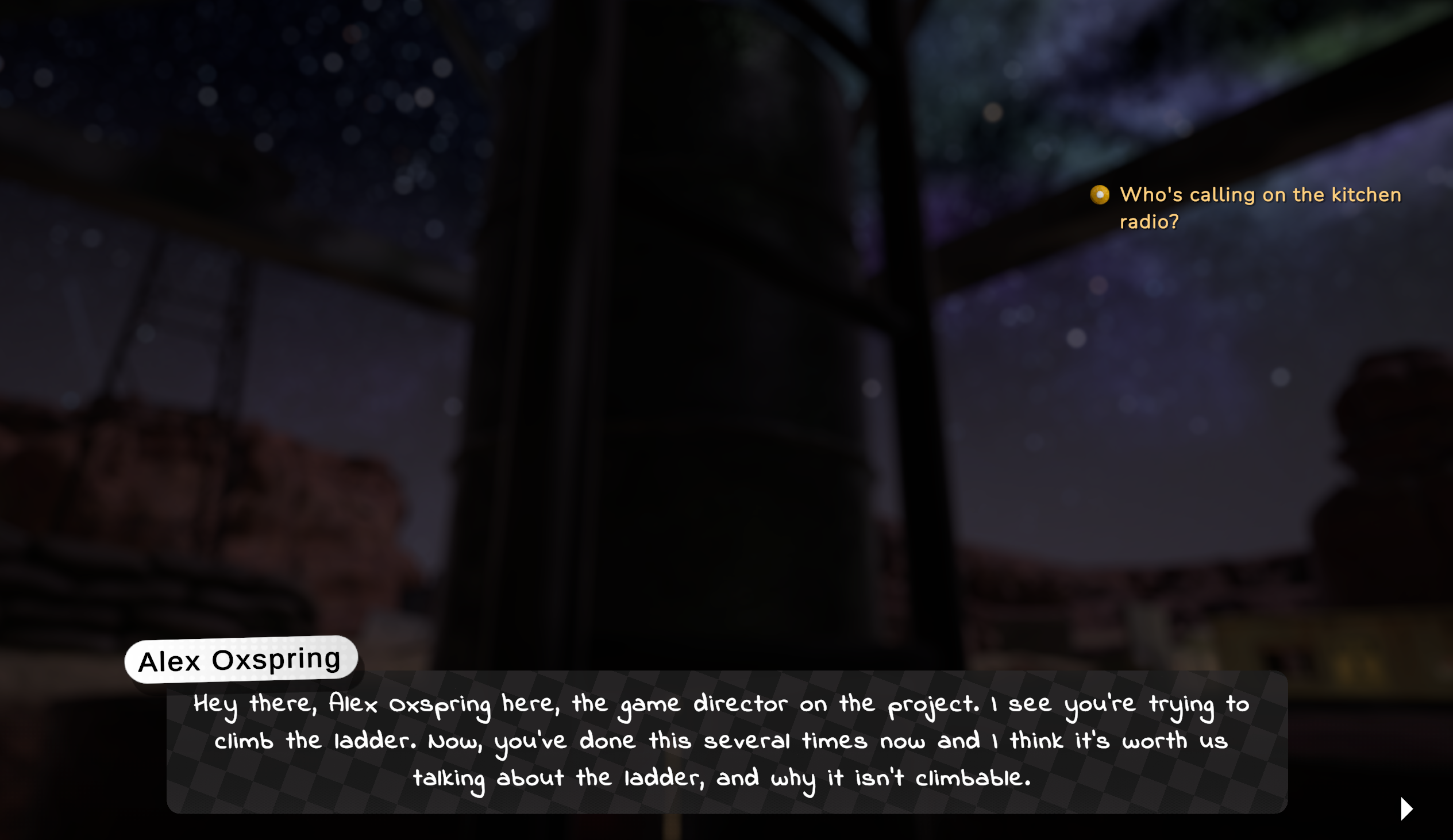
Another thing that Good Weird experiences do, is reward players curiosity. In Polyarmory we had a moment called The Ladder Bit, where players can attempt to climb an unclimbable ladder. Trying to interact with this ladder multiple times starts off a conversation chain where we break the forth wall, and provide the player with a fifteen minute long joke between the devs and the misbehaving player.
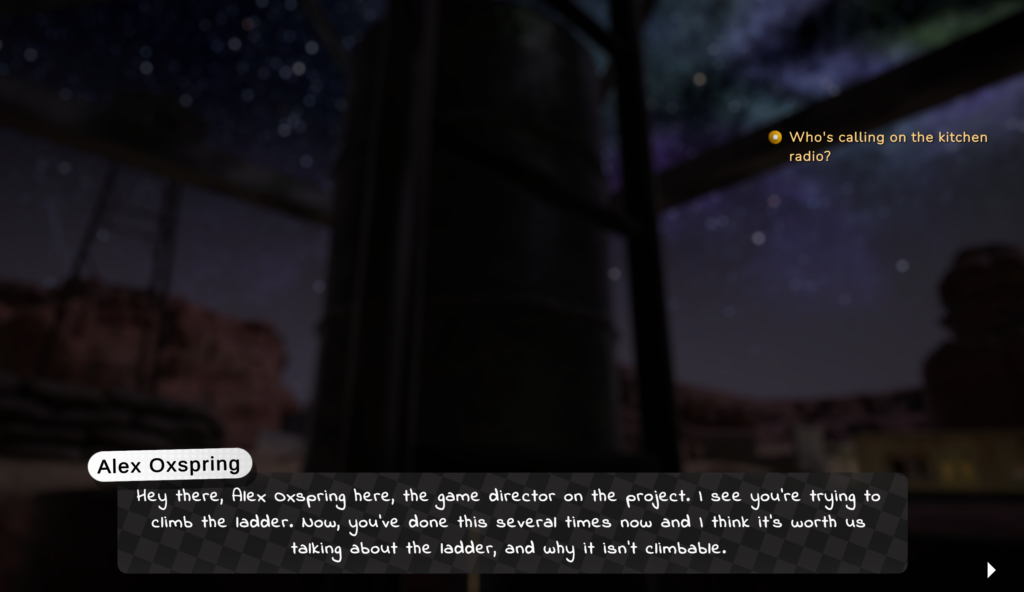
The Ladder Bit was so funny and resonated with players so much, that we’ve formalised the term Ladderification within Stupendium Softworks as shorthand for rewarding players with feedback for actions the player cannot do. We don’t want to provide affordances for interaction in our games that leave our players feeling disappointed that they can‘t do anything with them.
Thirdly, a good weird scene, vignette, or beat within an experience should always give back to the player and contribute to the overall experience. Things should not be random for randoms sake, they should have some purpose: that could be anything from provoking a specific emotion, creating an opportunity for a laugh, or building a moment we know is going to stick in peoples minds for a long time.
Another thing I like to heavily rely on in games I direct is a well-placed neck-breaking tonal shift. Whether that’s going from absurd gun violence to a heartfelt discussion about a persons place in the world, or vice versa, when a moment of deep introspective sadness is violated by the lyrics to Linkin Park’s In The End. These tonal shifts keep a game feeling like its taking you on an emotional rollercoaster. In fact, a game that does this absurdly well recently is the Resident Evil franchise – both Village and Requiem are mastersof the tonal shift, be it going from nine-foot tall vampire lady to flesh baby monster from the darkest recesses of hell, or the horror-filled moments of Grace’s storyline punctuated by action-shooter beats with Leon, respectively.
Finally, the best kind of weird feels entirely intentional – there’s method and reasoning behind the madness, and it doesn’t just throw nonsensical things at the player. Weird is best when there’s someone behind it in control, without that control, it stops being interesting and loses peoples attention.
A good example of a game that just treads on the borderline of good weird is Jazzpunk – it is fully able to lean into the absurdity of its world because of the way its digital world allows for nonsense to feel grounded despite being often on the cusp of random for randoms sake. The game pulls you in with its nonsense very early, rewards player exploration and mischief, and plays it all in a way that doesn’t pull you out of the experience.
It’s probably worth mentioning that good weird doesn’t always need to be comical though – there’s plenty of games out there that are weird, but maintain a serious tone. Dread Delusion is one of my favourite games of recent years for this very reason, the world that they have built in that game is inherently alien and strange, but they fully commit to that and it leads to a very hauntingly beautiful experience reminiscent of playing Morrowind for the first time.
Whenever we suggest a bit/gag/goof/joke in our late-night meetings at Softworks, these points above are always in the forefront of my mind – we don’t include random for the sake of random, because we think you deserve to play games that are smarter than that.
We want to tell stories that are always “Good Weird” and we’re going to keep that weirdness going for as long as we can. I’m excited to bring you along for that rollercoaster ride.
